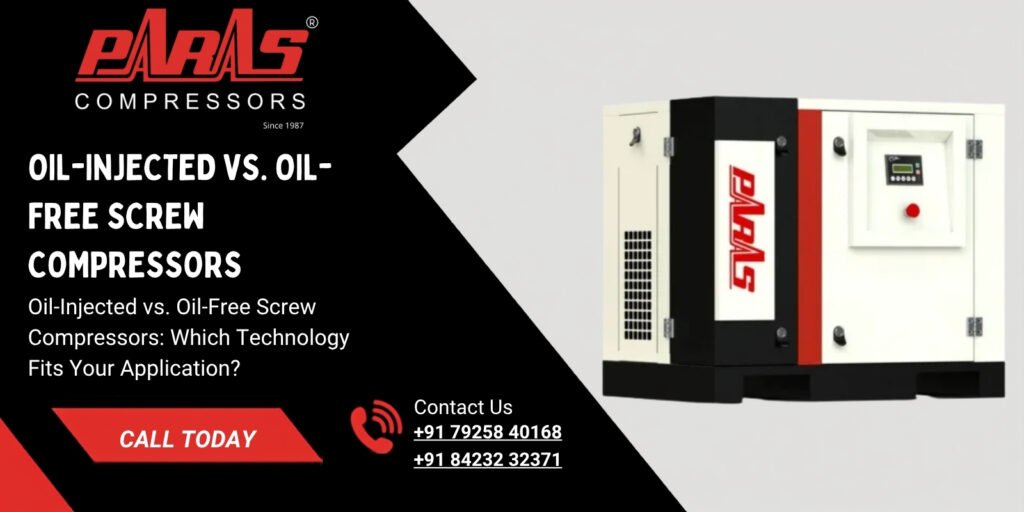
When designing or upgrading an industrial pneumatic network, selecting the right compressor architecture is critical. While previous guides have explored air ends, duty cycles, and drying technologies, one fundamental engineering choice underpins the entire system: Should you invest in an oil-injected screw compressor or an oil-free screw compressor?
While both machines utilize rotating helical rotors to generate high-volume compressed air, their internal lubrication strategies, purity outputs, and cost profiles diverge significantly.
1. Oil-Injected Screw Compressors: The Industrial Workhorse
In an oil-injected (or oil-flooded) rotary screw compressor, lubricating oil is sprayed directly into the compression chamber during the entire compression cycle.
How It Operates: As explored in our look at air ends, the injected oil absorbs compression heat, lubricates rotor bearings, and acts as an airtight seal to maximize volumetric efficiency. An oil separator downstream then removes the vast majority of the oil before air flows out to the Air Receivers and Air Dryers.
Best Suited For: General metal fabrication, machine shops, automotive assembly, wood-working, and heavy manufacturing where trace oil aerosols (captured by standard coalescing filters) pose no risk to end products.
Operational Advantages: Lower initial capital investment, exceptional energy efficiency, lower maintenance costs, and a remarkably long operating lifespan for the air end components.
2. Oil-Free Screw Compressors: Zero-Risk Air Purity
In an oil-free screw compressor, zero oil is allowed inside the compression chamber. The precision-machined male and female rotors are kept synchronized by external timing gears so they never touch, eliminating the need for internal liquid lubrication.
How It Operates: Because there is no oil barrier to seal the gaps, oil-free compressors typically use a two-stage design with complex rotor coatings and labyrinth seals to achieve target pressures without contaminating the air stream.
Best Suited For: Sensitive industries governed by strict ISO 8573-1 Class 0 purity standards—such as pharmaceutical manufacturing, food and beverage processing, semiconductor fabrication, hospital breathing air, and high-end chemical processing.
The Consideration: Oil-free units carry a significantly higher initial purchase price, consume more electrical power per CFM produced due to reduced internal sealing efficiency, and require more rigorous, specialized maintenance overhauls.
Making the Right Choice for Your Facility
To determine which technology matches your operational footprint, ask yourself one crucial question: What happens if a microscopic trace of oil contacts your final product or sensitive pneumatic equipment?
If contamination ruins your product (e.g., food packaging or medicine): You must invest in a certified oil-free compressor (or use an oil-injected machine paired with rigorous activated carbon filtration tower systems, though Class 0 oil-free remains the industry gold standard for zero-risk processes).
If your facility runs general pneumatic tools and automated machinery: An oil-injected Fixed Speed Screw Compressor or Variable Speed Drive Screw Air Compressor provides the most cost-effective, durable, and energy-efficient solution.
Conclusion & Next Steps
Matching your compressor lubrication technology to your exact industry purity requirements protects your brand reputation, prevents ruined production batches, and optimizes long-term capital expenditure.
Need expert advice on selecting the right industrial compressor? Explore our comprehensive lineup of high-efficiency Screw Compressors and reliable Air Treatment Equipment engineered for every industrial standard.
