
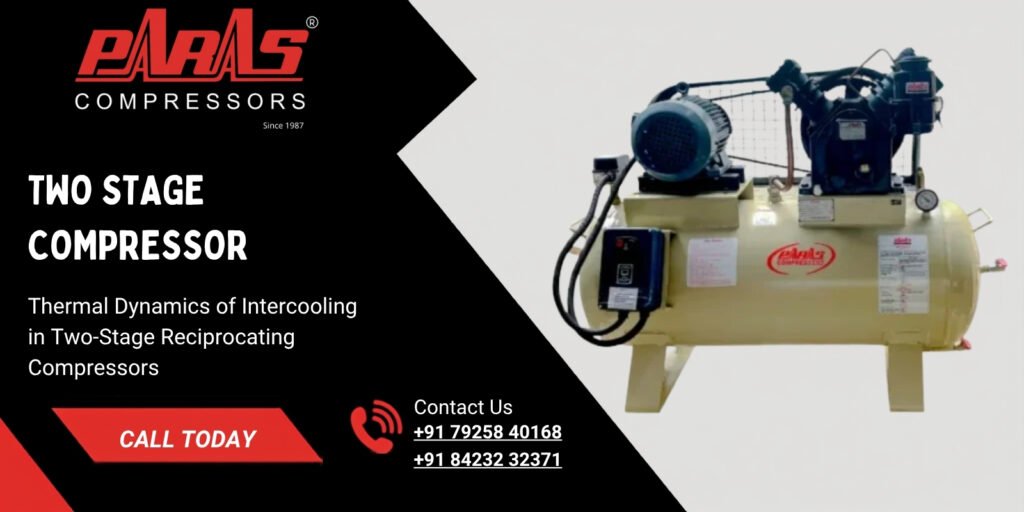
When industrial applications require high working pressures (typically above 7 to 10 bar or 100 to 150 PSI), standard single-stage compression encounters a severe thermodynamic limitation. As air is compressed into a smaller volume, its temperature spikes dramatically in accordance with the ideal gas law.
Handling this high heat load requires a multi-stage approach, making the Two-Stage Reciprocating Compressor the standard choice for heavy-duty workshops. A critical component in this architecture is the intercooler.
How Intercoolers Work in Two-Stage Units
In a two-stage reciprocating setup, air is drawn into the low-pressure (LP) cylinder and compressed to an intermediate pressure. Before this heated air enters the high-pressure (HP) cylinder for final compression, it is routed through an intercooler—typically a finned copper or aluminum tube assembly cooled by the compressor’s flywheel fan.
Core Thermodynamic Benefits:
Approaching Isothermal Compression: Pure adiabatic compression requires maximum work input because trapped air expands as it heats up. By cooling the air between stages, the intercooler brings the process closer to isothermal (constant temperature) compression, drastically reducing the total mechanical horsepower required to reach final target PSI.
Preventing Lubricating Oil Breakdown: High discharge temperatures carbonize standard crankcase and cylinder lubricants. Cooling the air mid-cycle prevents extreme heat buildup, protecting valve reeds, piston rings, and cylinder walls from thermal breakdown.
Enhancing Volumetric Efficiency: Cooler air entering the high-pressure cylinder is denser, allowing the compressor to deliver a higher mass flow rate of compressed air per stroke.
Maintenance and Troubleshooting Best Practices
Keep Finned Coils Clean: Dust, oil mist, and workshop debris clogging the intercooler fins trap heat, forcing both stages to work harder and increasing energy consumption. Regularly blow out or wash down intercooler surfaces.
Check for Condensation Traps: Because cooling warm air drops its temperature below its dew point, moisture condenses inside the intercooler tubes. Ensure automatic moisture drain valves or manual blow-down cocks are cleared regularly to prevent water carryover into the HP cylinder.
Protect Downstream Equipment: Efficient intercooling sets the stage for downstream air treatment. Pairing your multi-stage system with reliable Air Dryers and properly sized Air Receivers ensures clean, dry air at your end tools.
Conclusion
Understanding the thermal dynamics of intercooling helps maintenance teams keep heavy-duty reciprocating units operating at peak mechanical efficiency.
Looking for robust, high-pressure solutions? Explore our reliable Two Stage Compressors and industrial Reciprocating Air Compressors built for rigorous operating environments.
